May 3, 2026 | 5 min read
Do Not Move the Brass Lamp During Renovation
A businessman lets a contractor shift the brass lamp from his office shrine wall for the sake of a cleaner renovation and learns that some arrangements are not decorative.

Narrated by
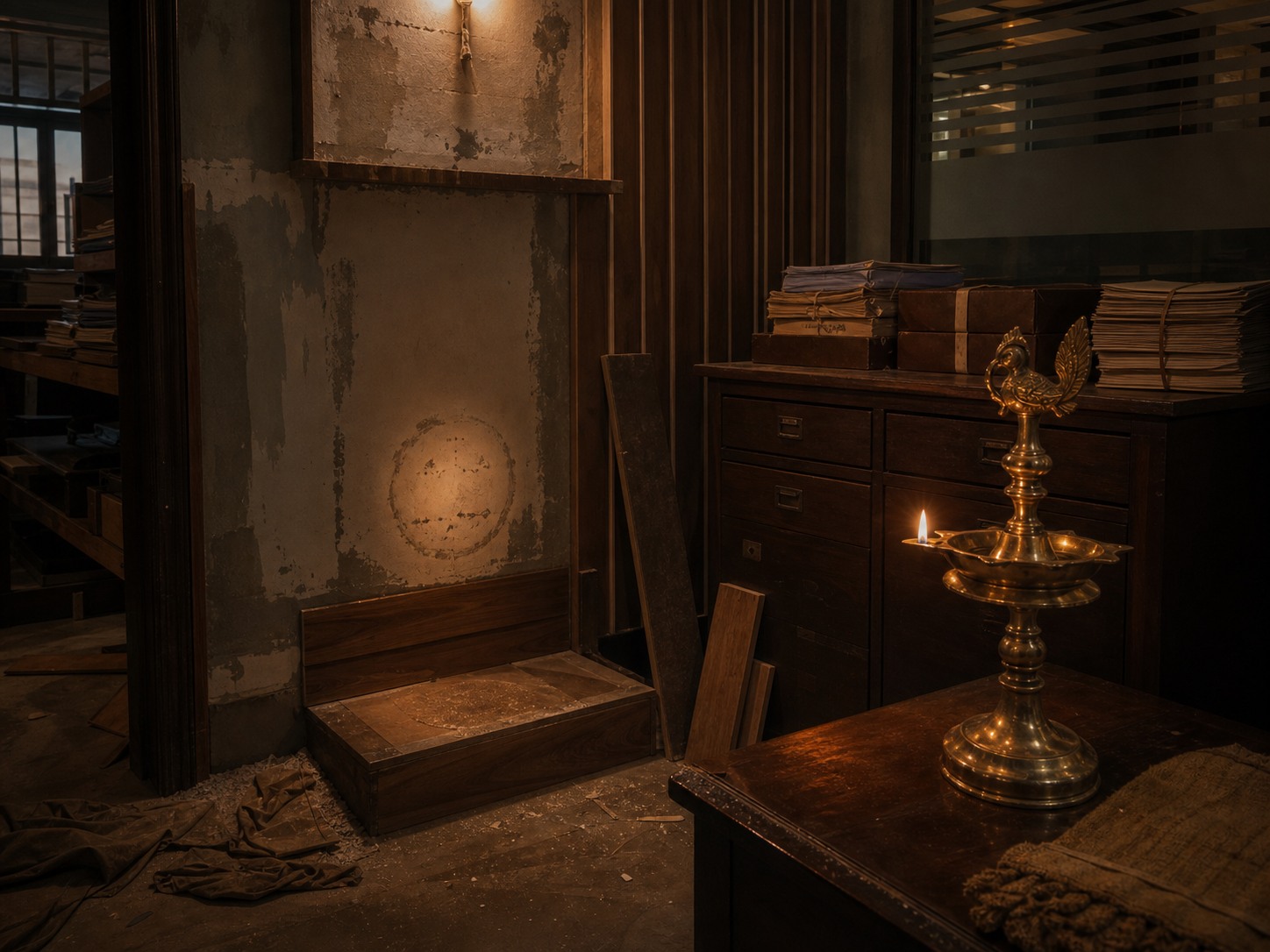
I am writing this because saying it aloud would make it sound smaller than it was. In daylight it was only a renovation, the sort of practical disturbance every old business requires eventually. We had taken the upstairs office above our wholesale shop apart in sections: false ceiling down, cracked plaster exposed, wiring replaced, ledgers boxed, old teak shelves removed for polishing. The contractor wanted clean lines. My mother wanted the shrine wall left alone until the closing prayer was done. I knew which side of that disagreement I should have honored. I chose the other one because the painter, the electrician, and three clients were all due that same week.
The wall shrine in that office is not grand. A framed Lakshmi image, a shallow brass bell, a copper plate for kumkum, and the old brass lamp my grandfather lit on the day he signed the first proper lease for the shop. We do not keep it there for atmosphere. The lamp is lit at the start of each financial year, before major agreements, and after any death in the family. The rule was simple enough that even our newest clerk knew it: during repairs, nothing on that wall was to be moved until the room was blessed closed again. Covered, yes. Cleaned, yes. Shifted, no.
On the second morning, the contractor called me upstairs. He was standing with his measuring tape against the wall, frowning as if the problem were purely visual. 'If we leave the lamp there, sir, the paneling line will break,' he said. 'Two inches to the right and everything will sit properly.' He said it in front of the carpenters, in front of my junior partner, and in front of a client who had arrived early and was already looking around at the dust. I did what I have done too often in my life. I treated a known rule as a private discomfort. I told him to move it carefully and put it back before my mother came up.
He did not touch the lamp with irreverence. That is partly why the mistake is mine. He wrapped it in a clean cloth, lifted it with both hands, and placed it on the account cabinet beside the door. Then he marked the wall, drilled the fresh anchors, and shifted the shelf by what could not have been more than the width of two fingers. The room looked better immediately. Straighter. More expensive. Even I could see that. When the men left for tea, I remained alone in the office and noticed that the patch of wall behind the lamp was darker than the rest, except for one pale ring at the base, clean as bone. Around that ring the drilling dust had settled evenly. Inside it there was nothing at all, not even the finest grit.
That afternoon the first duplicate invoice appeared. It was for labor we had already paid the week before: same amount, same handwriting, same red stamp, but dated three days ahead. My accounts clerk, Nilesh, brought it to me with the apologetic expression of a man who fears he has made a stupid mistake in front of someone who keeps score. I checked the bill against the file and told him to discard the second copy. He did. Ten minutes later it was back on top of the outgoing ledger, folded exactly as before, with a faint crescent of oil at the lower corner.
I did not mention the lamp. I said only that renovation dust was making everyone careless. Nilesh accepted the rebuke with more patience than I deserved, but from that day onward he stopped walking close to the shrine wall. He began taking a longer path around the room, squeezing past the steel cupboards instead. On the third evening I asked him why. He looked embarrassed, then lied in a way that insulted us both. 'There are loose wires there, sir.' The wires were on the opposite wall. We both knew it. After that, I noticed he no longer placed fresh files on the cabinet where the lamp had rested.
The next sign was smaller and worse. One of our oldest buyers from Surat arrived for a routine fabric discussion and sat across from me beneath the dismantled shelves. Halfway through our meeting, while I was explaining a freight delay, he interrupted and said, 'Rajeevbhai, you already told me this yesterday. Word for word.' He was not joking. His face had gone thin with annoyance. He repeated a sentence back to me that I had not yet spoken, including the part about port congestion in Nhava Sheva. Then he looked over my shoulder toward the brass lamp on the cabinet and asked why I had moved it to the door. I told him it was temporary. He canceled half the order before leaving.
That night I stayed late to review the contractor payments. At some point the market sounds below died away and the whole building entered that hollow post-closing silence every old commercial property has, when even the settling wood seems to listen. I was adding columns in the dim emergency light because the power had tripped twice already. Every figure was correct until I reached the renovation account. There the totals kept balancing only if I included one labor share too many. Remove it, and the books opened into mismatch again. Keep it, and the account closed perfectly. I checked every page by hand. There was no arithmetic error. There was only one extra share, sitting in the column as calmly as a seated man at the end of a dining table. The line carried no name, only the old internal code my grandfather used for expenses that were not to be questioned in open office.
I heard the brass bell before I looked up. Not a full ring. Just one light strike, as if a fingernail had touched it. The lamp was no longer on the cabinet. It was back on the shrine shelf, lit with a low, steady flame. The fresh paneling behind it had not been scorched, and yet the wick burned as if it had been fed recently. The room smelled of warm oil, wet plaster, and the faint sweet rot of marigolds that have been left one day too long. I remember noticing, absurdly, that the flame stood completely straight despite the ceiling fan being on.
I did not go near it. I am not proud of that. Instead I phoned the watchman downstairs and asked whether anyone had come up. He said no one had entered since the workers left. Then, after a pause long enough to make me grip the receiver harder, he asked whether we had reopened the upstairs office for prayer. I said no. He told me he had heard the bell twice from the staircase and had decided not to investigate because 'it did not sound like office work.'
The next morning my mother saw the lamp and knew immediately that it had been moved. Mothers often know more than the room has told them, but in this case the room had said enough. She did not raise her voice. That would have been easier to bear. She only asked, 'Who permitted this before closure?' I told her the contractor had misunderstood. She looked at me for a long time, then touched the shelf with two fingers and showed them to me. They came away grey with fine dust everywhere except the clean circle where the lamp sat. 'Then why,' she asked, 'is this place the only place in the room that has not accepted the dust?' I had no answer that did not sound like cowardice.
We arranged for the priest that evening. Until he arrived, the office behaved as if it had developed a memory it should not possess. Papers set beside the lamp drifted back to the right-hand edge of the desk where my grandfather used to keep his correspondence tray. Nilesh found an old key tied in red thread inside the new petty-cash drawer, though the key belonged to a safe removed twelve years ago after my father's death. When the contractor came to collect his advance, he stood at the threshold and would not step in. He said the layout looked unchanged to him, and he asked why we had called him twice after midnight. I had not called him at all.
During the closing prayer the priest did not ask many questions. He relit the lamp properly, circled the room, touched the new paneling, and recited under his breath with the efficient seriousness of a man who has seen households make preventable errors before. Then he stopped at the ledger table. His expression altered so slightly another man might have missed it. He asked how many working partners the business presently had. 'Two,' I said. Myself and my cousin. He nodded once and turned the main renovation ledger toward me.
At the bottom of the labor distribution page, beneath the two authorized signatures and the contractor stamp, there was a third allocation line in ink still darker than the rest: one share reserved, no withdrawal permitted. The signature under it was not mine, not my cousin's, and not any living clerk's. It was my grandfather's hand, the same deliberate rightward lean I have seen on old lease copies since childhood. The amount assigned to that share was exact. It was the amount we had saved by moving the lamp and finishing the room one day early.
We did not touch that page again. The priest told us to leave the amount unpaid in the books until a proper offering was made and the room had been used without profit for one full day. I did as instructed. Publicly, I explained the delay as a systems issue. That is how a respectable man survives his own fear. The client from Surat returned two weeks later and signed again without mentioning our previous conversation. Nilesh resumed walking past the shrine wall. The duplicate invoices stopped. Nothing else dramatic happened.
Yet I have never moved that lamp again, not even for cleaning. The paneling line remains imperfect by two inches, and every time I see it I feel a kind of gratitude sharpened by shame. The room accepted our renovation only after it recorded its own fee. Some nights, when I close the books after everyone has gone and the market noise has died below, I find a fresh teardrop of oil gathered at the lip of the lamp before the wick is lit. I wipe it away with my handkerchief and say nothing. That is how I know the arrangement is still being tolerated, not forgiven.