May 3, 2026 | 5 min read
The Flat Opened on the Wrong Muhurat
A property handover completed at a commercially convenient hour begins transferring more than ownership when the flat is opened on the wrong muhurat.

Narrated by
In property work, people speak as if possession begins when papers are signed and keys change hands. This is true often enough to make practical men arrogant. A flat, however, is not a warehouse unit. If a family has slept there, argued there, prayed there, hidden cash there, sat with its dead there, and taught children which switch not to touch there, the place develops terms of its own. Most of the time those terms remain polite so long as you remain polite first. The incident on Ashram Road cured me of treating timing as a ceremonial accessory to transfer.
The flat belonged to the widow of a retired civil engineer named Bhavesh Mehta. After her death, the two sons wanted a quick sale. They lived abroad, they were quarreling over valuation, and the housing society was already pressing them about maintenance arrears. I was asked to manage the handover because I knew the paperwork, knew the buyer, and had a reputation for finishing untidy family matters without requiring anyone to discuss grief in public. There had already been one delay due to title correction, one due to a bank remittance, and one due to a nephew insisting the small shrine niche in the kitchen be formally cleared before outsiders entered as owners.
That final point should have slowed me down. Instead it irritated me. Not because it was wrong, but because by then everyone involved was using ritual as another bargaining lever. The buyer, a dentist from Navrangpura, had already booked carpenters for the next morning. The sons wanted the final tranche released before the weekend. The priest the nephew preferred was unavailable until the following day. My own mother, when I mentioned the matter over lunch, asked only one question: 'At what hour will they open the house?' I told her we had not fixed it yet. She said, 'Then fix that before you fix anything else.'
I did fix it. I fixed it badly.
The auspicious morning slot passed while one of the sons argued on speakerphone from Toronto about TDS deductions he had already approved by email. By the time the bank call ended, the buyer's agent was pacing the landing, the society secretary was muttering about lift bookings, and everyone had begun using that tone respectable people adopt when they want you to absorb the cost of their impatience. There was another favorable muhurat just after dawn the next day. There was also a perfectly convenient hour at 6:40 p.m., when all signatures were finally in place and the building watchman was free to witness the transfer. I chose convenience and told myself we would allow the buyer's wife to do a brief threshold prayer on entry. I have seen many men use small correctness to excuse larger disorder. That evening I joined them.
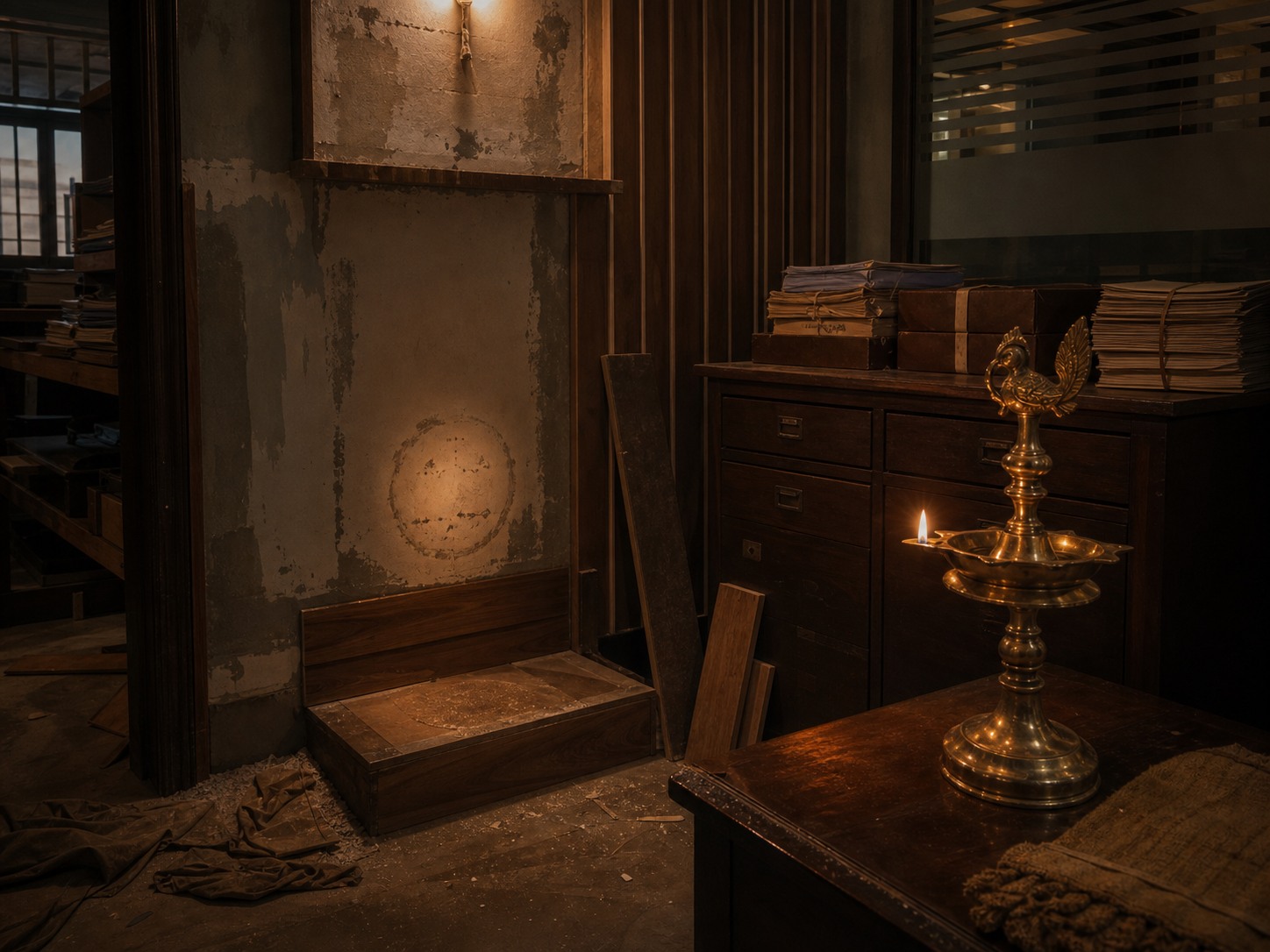
The flat was on the fifth floor, east-facing, with a narrow foyer, a long sitting room, and a kitchen whose back window looked onto another block's water tanks. It had already been half-emptied. Curtains removed. Crockery packed. Bedroom cupboards standing open like extracted teeth. But the place was not neutral. The widow's sons had stripped it for sale while leaving behind those things families postpone because they do not know how to classify them: a steel dabba of old keys, two cracked framed photos, a rolled-up prayer mat, moth-eaten wool shawls, a switchboard label written in blue pen by someone who is no longer alive. In the kitchen niche, the brass oil mark from the removed lamp was still visible though the idol shelf had been cleared.
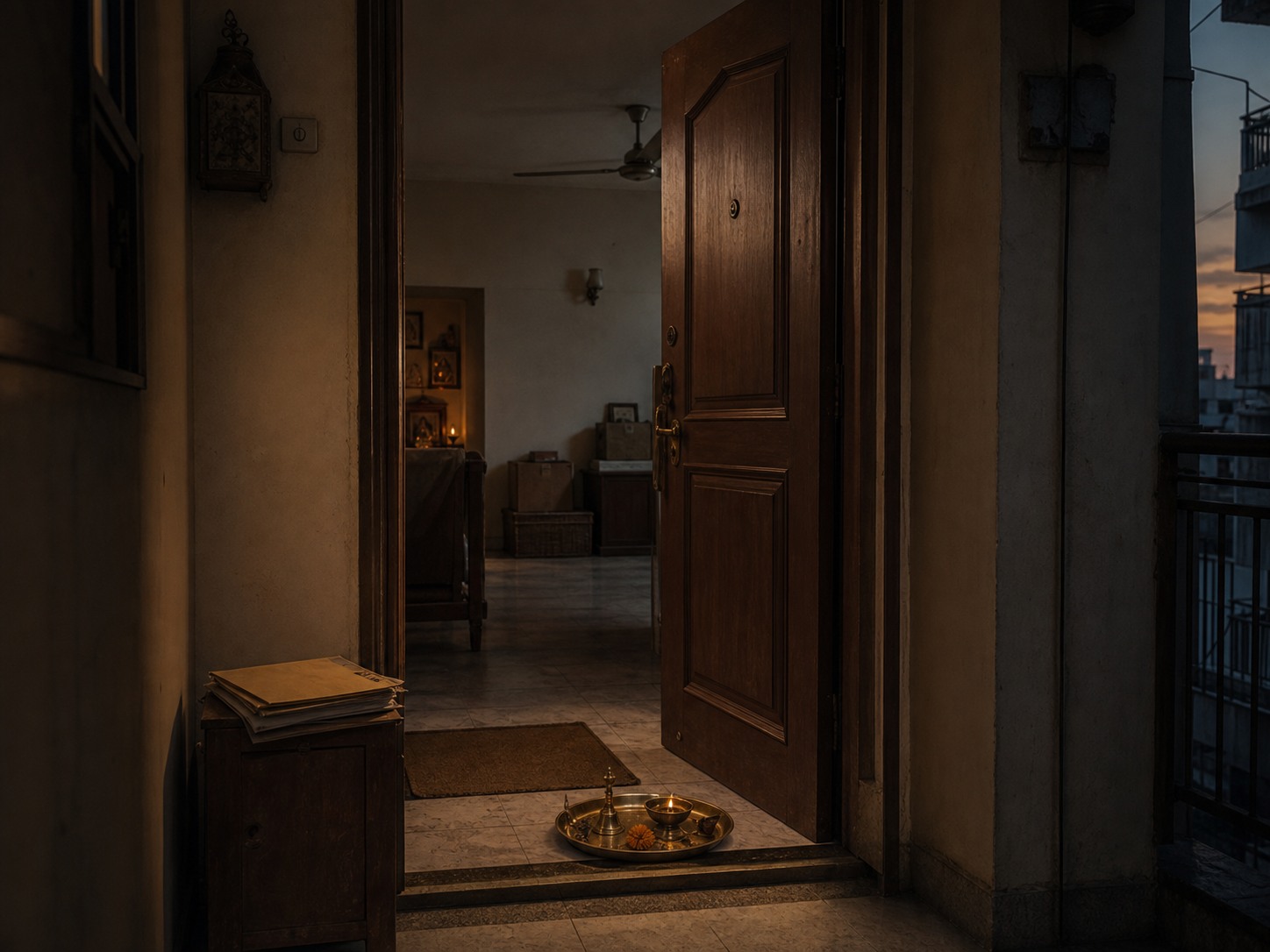
The buyer's wife arrived carrying a pooja tray with rice, kumkum, flowers, and a small ghee lamp in a stainless cup. She asked, in a quiet voice almost lost beneath everyone else's practical noise, whether the previous household had done the final exit prayer yet. The elder son said yes too quickly. The nephew said not fully. I should have stopped there. Instead I asked whether there was at least no objection to her entering first with the tray. Everyone agreed because agreement is easy once the wrong decision has already been made.
At 6:40 p.m. I unlocked the door.
The first thing that happened was so minor none of us treated it properly. The buyer's wife stepped over the threshold, tilted the tray, and the little ghee lamp went out without smoke. Not flickered. Out. The corridor had no draft. She apologized as if the failure were hers. Her husband laughed and said these ready-made wicks always disappoint. The nephew bent immediately to relight it, then paused, staring at the blackened cotton. 'It is wet,' he said. It was. I saw it myself. The wick looked as though it had been dipped in water, though the tray had not tipped and no oil had spilled.
We went in anyway.
The handover took another fifteen minutes because convenience always breeds one more inconvenience. The society secretary wanted the meter reading noted in front of witnesses. One son asked for a photograph of the key exchange for the family group. During all of this, the buyer's wife kept the unlit tray near the kitchen entrance, waiting for a proper moment no one gave her. As we moved from room to room, I began to notice that doors we had already opened were standing closed behind us. Not slammed. Simply shut, with the patient exactness of a flat correcting posture.
The smallest bedroom was the first to resist classification. It had been cleared for repainting except for a low steel cot frame stacked against the wall. The buyer's little daughter, who had until then been bored and whispering to herself about curtain colors, stood in that doorway and asked her mother why 'Ba' was sitting on the floor in the empty room. Nobody answered at once. Children are often ignored in property transactions because adults are busy behaving efficiently. The girl pointed to the corner beside the plug board and said, with the same mildness she might have used to identify a schoolteacher, 'She is asking why the evening lamp has not been turned toward the kitchen yet.'
The buyer's wife took her by the wrist hard enough that the child winced. The room was visibly empty. I checked it myself. But on the floor tiles in that corner lay a half-moon smear of wet ash, as if the base of a small brass diya had been turned there recently and lifted away. The nephew saw it and made the sign people make when they do not want to be seen making it. The younger son swore under his breath and said some worker must have left cement dirt. It was not cement. It smelled faintly of old wick oil.
I told everyone to finish quickly. That was my contribution to the problem at that stage: not correction, only acceleration. We completed the signatures on the dining ledge because the table had already been moved. When I set the final acknowledgement file down, I found that the top page had taken an impression from something beneath it. Not writing. A pressure pattern, circular and petaled. I lifted the file. Under it lay a fresh marigold, flattened as neatly as if it had been closed in a book for years, though no flower had been there a moment earlier. The petals were still damp.
The buyer no longer laughed after that. He asked his wife to perform whatever remained of the entry prayer at once. She returned to the tray, relit the lamp in the corridor, and this time it held long enough to carry inside. She walked to the kitchen niche, set down the tray, and froze. The niche shelf we had all seen empty now held a stainless tumbler half full of water and two grains of uncooked rice pressed into the moisture at the rim. One of the widow's sons made a sound I had not heard from an adult man in years. Not a word. A child's refusal to recognize what is in front of him.
The buyer's wife backed away and said the flat should be closed until morning. Sensibly, this would have been the end. But money had already changed hands, the watchman had signed, and all of us were by then trapped inside the logic of completed transactions. The buyer asked whether he could at least leave a small idol overnight to mark possession. The nephew said no new possession should be marked before the old one had been released properly. The elder son shouted that released or not, the flat was sold. At that exact moment the kitchen window slammed once, though it had been latched from inside since before we entered.
Then the lights in the flat went out. The corridor lights remained on. So did the neighboring flats. In the dim spill from the entrance I saw the sitting room take on a shape it had not held all evening. The packed shawls, the rolled prayer mat, the steel key tin, the two cracked photos on the counter, even the abandoned tumbler in the niche, all of it looked less like leftover property than like a house paused midway through its own closing ritual. The buyer's little girl began reciting, in a careful elderly cadence that did not belong to her, the first lines of an evening prayer for household peace. Her mother clapped a hand over the child's mouth. The child bit her hard enough to draw blood.
We left in disorder. There is no respectable way to phrase it. We did not conclude the moment; we abandoned it. The buyer's wife carried the child downstairs. The younger son refused to lock the kitchen side first and took the staircase rather than the lift. The society secretary, who had been skeptical of every delay all week, stood outside the door and would not cross the threshold again even to retrieve his pen. I locked the flat myself. As I turned the key, I heard movement from inside: not footsteps, but the soft domestic sequence of a house settling into evening. A metal tumbler placed down. A cupboard door touched shut. Then, distinctly, the scrape of a lamp being rotated toward a room that needed it.
The buyer demanded reversal the next morning. Legally he could not reverse it. Practically, no one wanted to force occupation after what had happened. We spent three days converting a completed handover back into an incomplete one without using those words. The priest came on the fourth morning, before sunrise, and performed the exit prayer the nephew had requested from the beginning. Only after that did the buyer's wife re-enter with a fresh tray at the proper hour. The lamp stayed lit. The kitchen niche remained empty. The little girl remembered nothing except that her mother had been angry about the bite. When they finally crossed the threshold again, the brass oil stain in the empty niche had dried into a clean oval facing outward, as though the lamp had already been turned toward the door and was finished watching us leave.
The sale eventually went through, though not at the original price. There was repainting again, another society witness, and a second set of signatures. On paper the first transfer remains valid enough to be annoying and invalid enough to be useless, which is a category property law understands better than people do. I keep the duplicate key receipt from that evening in a separate envelope because the carbon copy has one line pressed deeper than the others, though no extra words were written there: possession acknowledged, residence pending.
If this sounds like the language of an anxious man reading too much into clerical residue, you may take that view. Outwardly I still speak as if timing matters because it calms families and reduces argument. It is simpler that way. But I no longer open an inherited home at a convenient hour merely because the bank has closed, the buyer is ready, and the witnesses are tired. A flat can accept a new owner while refusing to conclude the old one. If you force the threshold at the wrong time, the house may let the paperwork enter first and keep the rest of you waiting outside. I know this because the duplicate key receipt from that evening still leaves a faint ring of oil on whatever paper lies beneath it, though the envelope has remained dry for months.