May 2, 2026 | 5 min read
The Fence That Remembered the Gale
A coastal boundary repair goes wrong when the builder realizes the old posts were not broken. They were bracing.

Narrated by
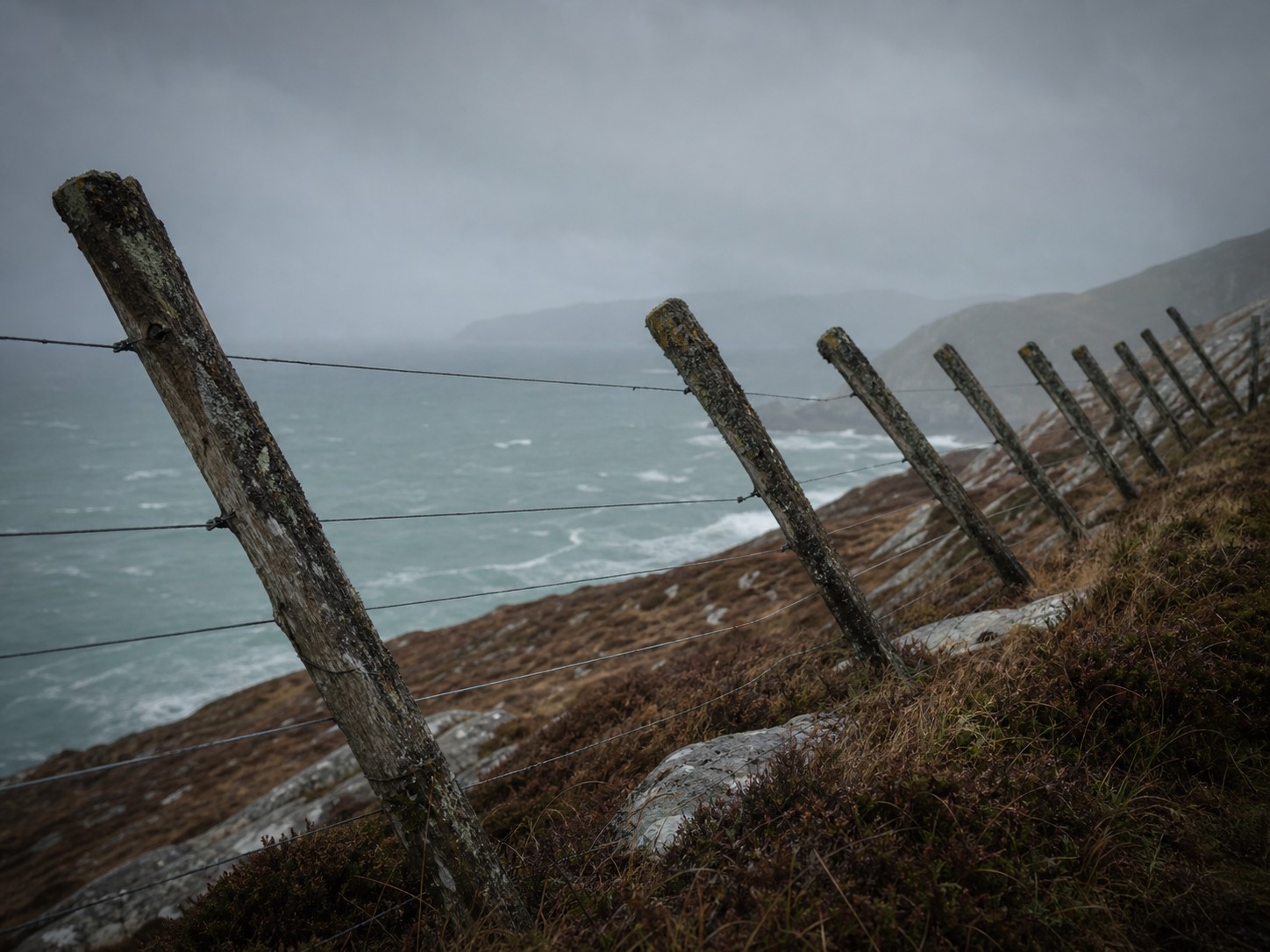
The Great Gale of '87 is a ghost story for most, but on the Coigach coast, it's a structural reality. I was hired by a man named Grier to replace a deer fence that had spent forty years leaning at a precise forty-five-degree angle. He called it 'storm damage.' I called it a pre-stressing of the landscape, but my winch was already paid for.
The old posts were larch, grey and salt-bitten, yet they refused to rot. They stood in a perfect, slanted line as if leaning into a hurricane that had never quite finished passing through. When I put my hand on the wood, it didn't feel like dead timber. It felt like a muscle under maximum load, vibrating with a frequency that made my fillings ache.
The local shepherd didn't even get off his quad bike when he stopped. He just watched me set the winch. 'The gale is still in the wood, Alasdair,' he said, his voice as dry as the peat. 'If you pull those up, you're not clearing a boundary. You're unpinning a weight that's been looking for a place to fall for half a century.'
I'm a man of levels and plumb lines. I ignored him and engaged the winch. The first post came up with a sound like a bone snapping in a vacuum, and the scent of ozone and salt-spray—sharp and fresh as if it had been bottled yesterday—erupted from the hole. The air in the glen didn't move, but my ears popped as if I’d just been dropped into a deep-sea trench.
By the third post, the 'second sign' arrived. I wasn't alone on the ridge anymore. The silence had a shape to it—a pressure. I looked through my transit level and saw a curlew suspended in mid-air, three feet above the heather. It was stone dead, its neck snapped, pinned against an invisible wall of air that shouldn't have been there. It looked like a specimen pinned to a board of nothing.
I should have stopped. Instead, I winched up the fourth post. The ridge didn't shake. It exhaled. A low, rhythmic thrumming started in the remaining larch posts, a vibration so violent that the wire began to hum a note I’d only ever heard in the middle of a North Atlantic surge. Then the wire didn't just snap; it dissolved into iron dust.
Then the 'debris' started hitting. Not from the sky, but from the empty air to the west. I heard the impact of slate hitting wood, the scream of tearing metal, and the heavy thud of timber—but there was nothing to see. Only the sounds of a house being demolished by a storm that had happened forty years ago, playing out in real-time in the middle of a clear, still afternoon. I felt the heat of phantom friction on my face.
I looked back at the holes I’d made. The ozone smell was gone, replaced by the stench of old, stagnant water and the copper tang of blood. Something had finally crossed the boundary I’d unpinned. Through the transit lens, I saw the air distort—a heat-shimmer in the shape of a massive, roaring wall, moving toward Grier’s new house at the foot of the ridge, carrying the jagged shadows of things it had destroyed decades ago.
I didn't wait to see it hit. I left the winch, the truck, and the rest of the larch posts where they lay. I drove the quad bike down the goat path, my teeth rattling from the pressure change. When I looked back from the village road, Grier’s house was still standing, but the windows were gone. Not broken—they had been sucked outward, as if the house had tried to catch its breath and failed, its interior contents now painted in a fine mist across the heather.
The shepherd was waiting at the village pub. He pushed a dram toward me, his eyes fixed on the ridge. 'The gale didn't end in '87, Alasdair,' he said. 'It just found a place to lean. You shouldn't have given it a reason to stand up straight. Now it's looking for a new place to rest.'
I don't go back to Coigach now. But sometimes, on a perfectly still night in the Highlands, I’ll hear a fence wire snap in the distance, and I’ll feel that sudden pop in my ears, and I’ll know that somewhere, the air is trying to remember how to be a storm again.