May 2, 2026 | 4 min read
The CCTV at the Glen-Edge Pumps
A remote petrol station's security footage begins showing a woman who only appears seconds before the power fails during a storm.
Narrated by
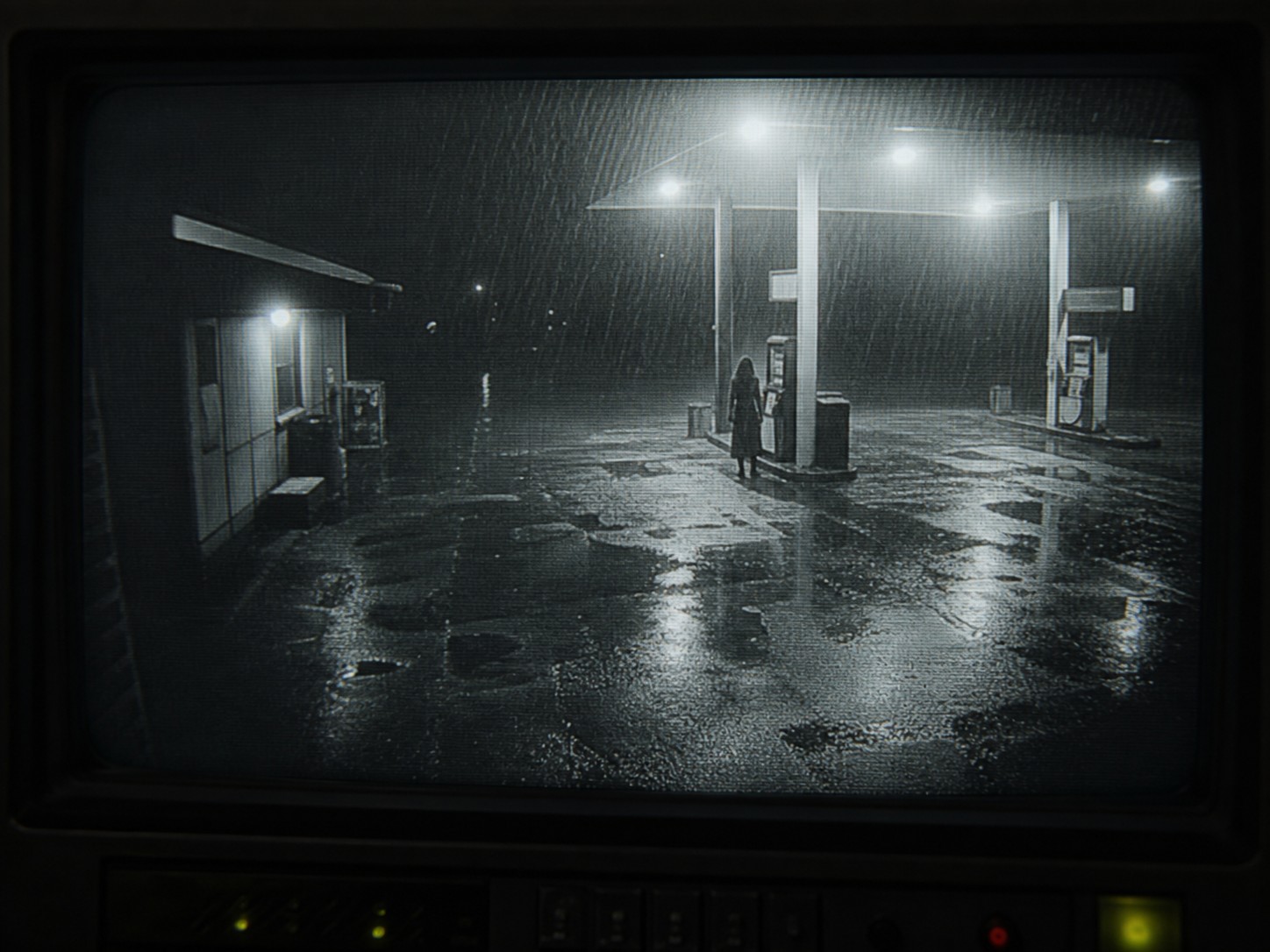
I was working the night shift at the Glen-Edge station, a lonely stretch of tarmac between Inverness and nowhere. It was a night of 'unseasonable' weather—the kind of wind that makes the signs rattle like they’re trying to warn you about the next mile. I was watching the CCTV monitors, mostly to keep the dread of the empty glen from settling in my chest.
At 2:44 a.m., the screen for Pump 4 flickered. A woman was standing there. She wasn't holding a nozzle; she was just looking directly into the camera. She wore a yellow raincoat that looked too bright for the grainy black-and-white feed—it was the only thing on the screen that seemed to have its own light. Her face was a blur of static that moved independently of her body.
I looked out the window. The forecourt was empty. The rain was lashing against the glass, but there was no one at Pump 4. I looked back at the monitor. She was still there, but now she was closer. She was standing at the edge of the frame, her hand reaching out as if to touch the lens, and I saw her fingers were long, pale, and lacked fingernails.
Then the power went. The monitors died, the fridge hummed into silence, and the only light came from the lightning flashes over the glen. In the darkness, I heard the sound of the shop door chime. *Ding-dong.* But the door didn't move. The chime was coming from the speaker on the CCTV console, over and over, accelerating into a mechanical scream.
I grabbed my torch and swept the beam across the shop. Nothing. I went to the window and looked out again. In a flash of lightning that lasted a second too long, I saw her. She was standing right against the glass, her face pressed into the pane. She wasn't wearing a yellow raincoat. She was wearing a shroud of wet, grey wool, and her mouth was a wide, dark hole that leaked black oil.
She didn't speak. She just tapped on the glass—a sharp, rhythmic sound that matched the pulse of my own failing heart. *Tap. Tap-tap. Tap.* I realized it wasn't a knock. It was a countdown. Every tap sent a hairline crack through the reinforced glass, spreading like a spiderweb toward my face.
When the power finally returned an hour later, the CCTV footage for that hour was gone. Not overwritten—it had been physically erased from the platters. But on the monitor for Pump 4, a single frame had burned into the screen. It was the woman, standing in the middle of the road, pointing toward the station. Her raincoat was now a dark, bruised red.
The storm hit ten minutes later, a mudslide that took out the road and the station's storage tanks, burying the shop in six feet of slurry. I survived because I’d already run for the high ground. I still don't know who she was, but sometimes when the weather turns, I’ll see a flash of yellow in the corner of my eye, and I’ll hear that *ding-dong* from a dead speaker, and I’ll know it’s time to leave.