May 2, 2026 | 5 min read
The Chair That Counted Cups
At a Highland funeral tea, the furniture starts measuring the guests by the number of empty cups left behind.
Narrated by
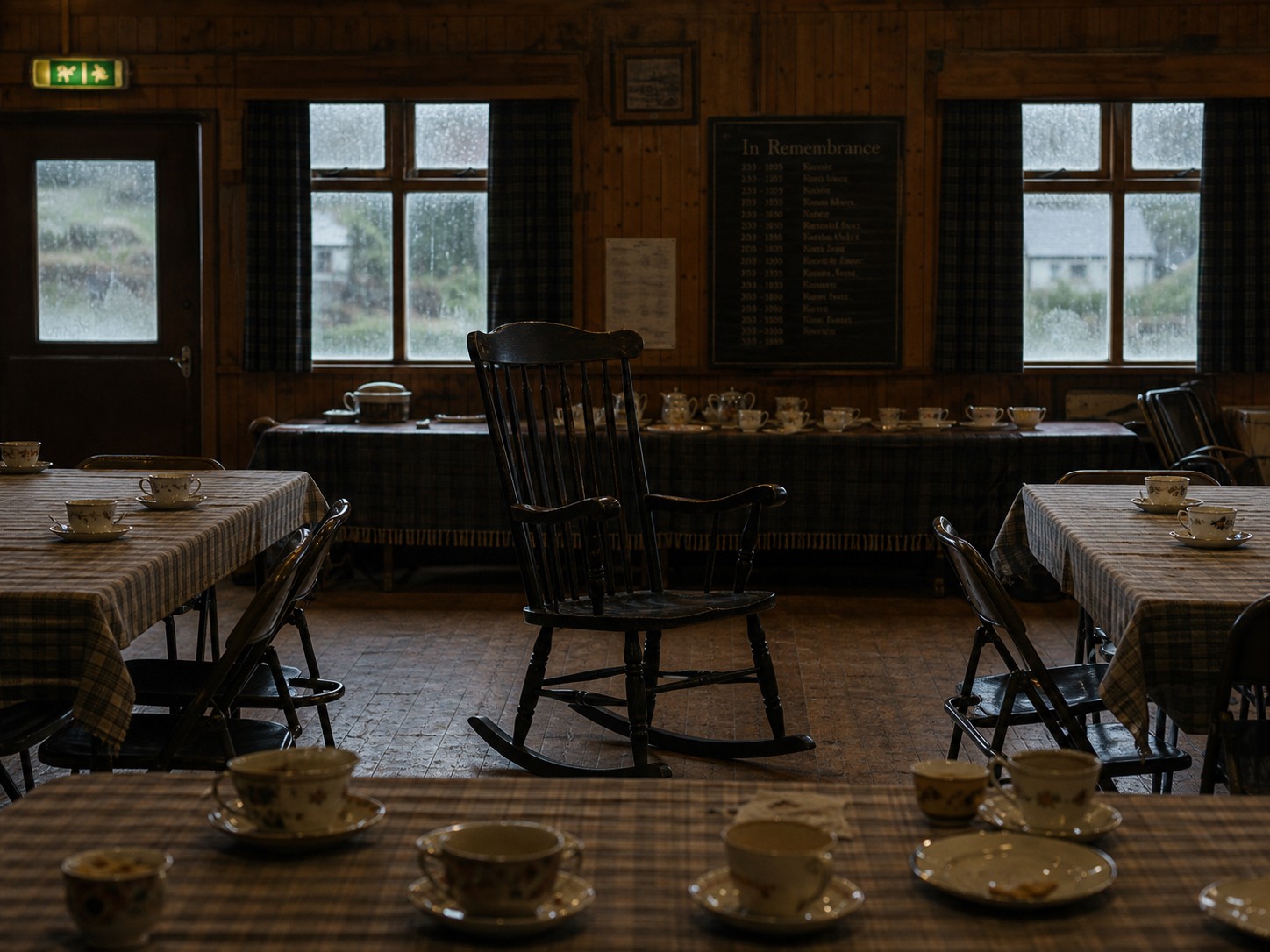
Old Angus had been a man of few words and many grudges, so his funeral tea in the Drumnadrochit hall was a muted affair. The rain was doing its usual Highland duty—a steady, vertical grey that turned the car park into a lochan. Inside, the steam from twenty kettles had slicked the windows until the world outside didn't exist. It felt like being inside a lung.
I was helping the ladies with the service when I noticed the chair. It was Angus’s own rocking chair, brought from the cottage because his sister insisted he needed to 'be present' for the wake. It sat in the corner, empty and still, until the first tray of tea was cleared. I’d placed it there myself, checking the joints for any play.
I set a stack of dirty cups on the trestle table, and that’s when the first rock happened. A slow, rhythmic creak—the sound of seasoned oak under tension—that shouldn't have been possible in a room with no draft. I looked at the chair. It wasn't just moving; it was settling, the wood groaning as if a heavy, wet weight had just taken a seat.
Mrs. MacLeod stopped mid-pour. She didn't look at the chair. She looked at the tray. 'How many cups did you just bring back, Alasdair?' she asked, her voice dropping to a whisper that cut through the chatter of the room like a cold blade.
I counted them. 'Twelve,' I said. She turned even paler, her hand trembling. 'There were only eleven people at that table. Count the guests, then count the cups again. If the chair rocks, the number is always wrong. Angus never could stand a missing guest.'
I did as she asked. Eleven men from the kirk session. Eleven living souls. But when I looked back at the tray, there were thirteen cups. A fresh one had appeared among the dregs—a chipped china piece with a pattern of bluebells that Angus’s mother had used sixty years ago. It was filled with a tea that smelled like peat smoke and old wool.
The chair rocked harder, the rhythm accelerating. The creak became a groan of timber, and the floorboards began to vibrate with a heavy, thudding pulse. Then the guests started to notice. Not the chair, but their hands. One by one, they looked down and realized they were holding two cups instead of one—identical twins fused together by the ceramic.
Angus’s sister stood up, her face a mask of old, sharp grief. 'He always hated a half-empty room,' she said, looking directly at the empty rocking chair, which was now moving so violently it seemed it might splinter. 'He’s just making sure no one leaves until the guest list is full. And he’s brought the ones we forgot to invite.'
The hall doors slammed shut. The bolt didn't slide; it disappeared into the wood, the grain closing over it. I looked at the tray again. There were now forty cups. The extra cups were filled with a liquid that wasn't tea—it was thick, black, and smelled of the deep earth. Small, pale fingers began to reach over the rims of the cups.
We stayed in that hall until the sun came up and the chair finally stopped moving, its wood now stained a dark, permanent black. When the doors finally opened, the extra cups were gone, but every guest left with a faint, circular burn on their palm, the size of a tea cup’s base. I still have mine; it turns cold whenever I hear a rocking chair in an empty room.